


You may also like
-
The Dove, No. 1 Poster
Hilma af Klint · 1915 · Mystical abstract poster built from sacred geometry in soft pink, yellow, and grey
Poster from €9 · Framed from €16
Regular price From €6,00Regular price -
Doves No. 2 Poster
Hilma af Klint · 1915 · Lyrical abstract art print with dove symbolism and pastel-toned geometric forms
Poster from €9 · Framed from €16
Regular price From €6,00Regular price -
The Ten Largest No 7 Poster
Hilma af Klint · 1907 · Radiant abstract art print with swirling biomorphic forms on a sunlit yellow field
Poster from €9 · Framed from €16
Regular price From €6,00Regular price -
The Ten Largest No. 3 Poster
Hilma af Klint · 1907 · Radiant abstract art print with spirals, petal forms, and floating symbols on orange
Poster from €9 · Framed from €16
Regular price From €6,00Regular price


-

"Very nice Posters. The quality is amazing and we received it very quickly !"
-

"A shop to visit absolutely. Huge selection of posters. We spent more than an hour there !"
-

"Perfect to find gift. Price are very good. An they can frame and pack it on site"


About the Artist
Hilma af Klint was a Swedish pioneer of abstract painting whose visionary work emerged in parallel with, and often ahead of, early modernism. Working largely outside the mainstream art world, she developed a unique visual language inspired by spiritualism, geometry, and the search for hidden patterns in nature and thought.
Today, her legacy is celebrated in famous artists collections for her groundbreaking approach to abstraction and her influence on twentieth-century art. Her prints invite viewers to contemplate both the visible and the invisible, making them enduring favorites among those drawn to symbolic and meditative art.
The Artwork
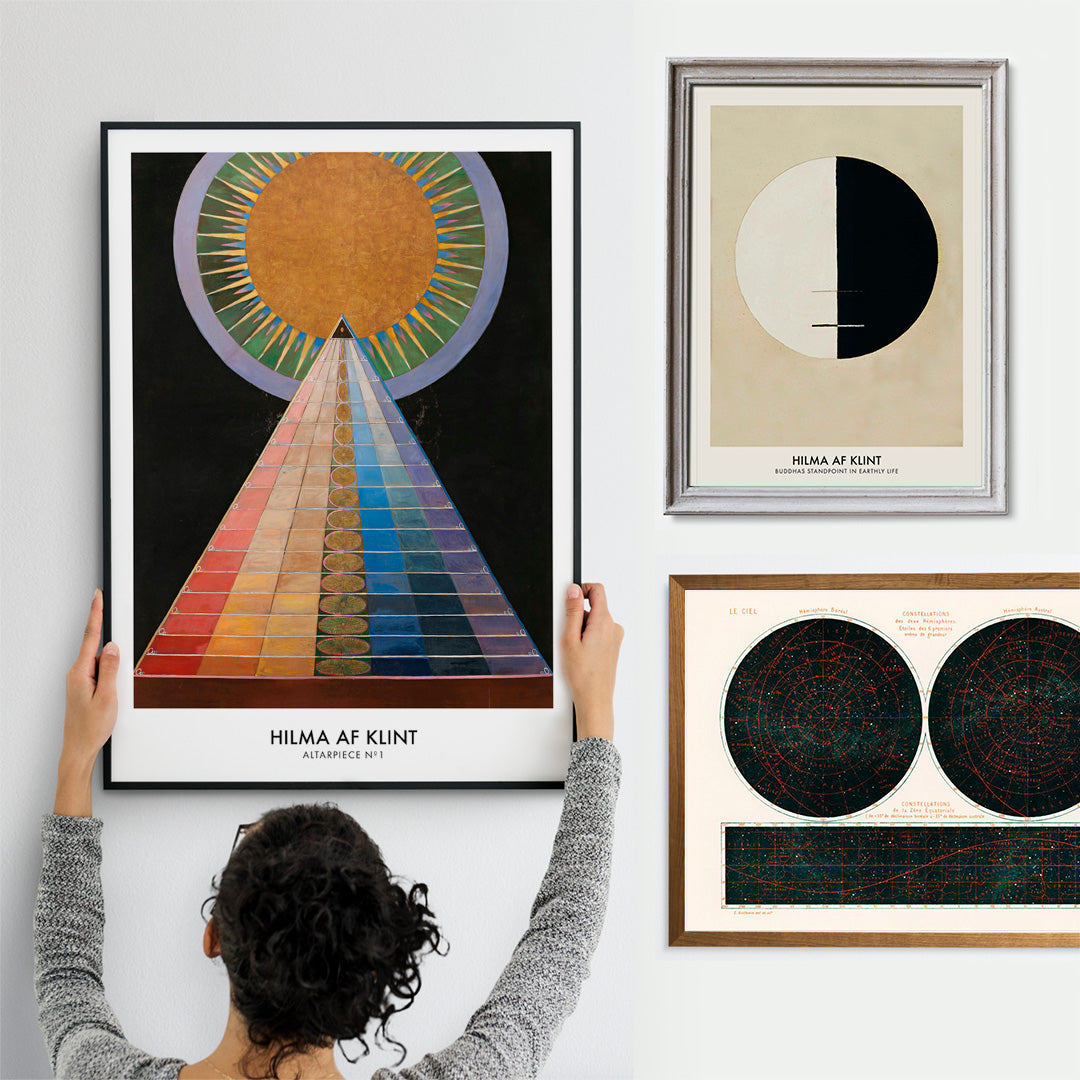
Altarpiece No. 1 was created in 1915 as part of a series intended for a spiritual temple, reflecting Klint's belief in art as a means of connecting with higher consciousness. Conceived as a culminating statement, the work was designed to guide viewers toward contemplation and inner transformation, rather than simply to decorate a space.
This piece emerged during a period of intense exploration into esoteric philosophies and theosophy, aligning with the broader fascination for spiritual diagrams and cosmological systems found in early twentieth-century Europe. Its presence in esoteric art collections underscores its role as a bridge between the material and the metaphysical.
Style & Characteristics
The composition features precise geometric forms arranged along a strong vertical axis, with a radiant circular motif at the center evoking the sun. The palette is striking, with a deep black background setting off luminous yellow, vivid blue, and touches of red and purple.
Clean lines and symmetrical shapes give the work a sense of architectural order and calm, while the interplay of color and form creates a quietly dynamic energy. The overall effect is meditative yet powerful, making it a distinctive example of geometric abstract art from the early twentieth century.
In Interior Design
This art print serves as a striking focal point in modern interiors, especially in living rooms, studies, or meditation spaces where thoughtful design is valued. Its vertical orientation is ideal for narrow walls, entryways, or above a console, and it pairs beautifully with pale wood, matte black frames, and neutral palettes.
For a cohesive gallery wall, combine it with abstract posters, or let it stand alone against white or beige walls. Its bold use of blue and yellow makes it a compelling choice for interiors seeking both color and symbolic depth.