


You may also like
-
Blue set of leaves Poster
Owen Jones · 1856 · Ornamental blue leaf botanical print with crisp symmetry and elegant Victorian design
Poster from €9 · Framed from €16
Regular price From €6,00Regular price -
Colorful flower pattern Poster
Owen Jones · 1867 · Vibrant floral poster with rhythmic Victorian ornament and crisp, repeating symmetry
Poster from €9 · Framed from €16
Regular price From €6,00Regular price -
Green Botanical pattern Poster
Owen Jones · 1867 · Victorian botanical print with rhythmic green foliage and bright floral accents
Poster from €9 · Framed from €16
Regular price From €6,00Regular price -
Flower pattern Poster
Owen Jones · 1912 · Refined floral pattern poster with crisp symmetry in red and blue on white
Poster from €9 · Framed from €16
Regular price From €6,00Regular price


-

"Very nice Posters. The quality is amazing and we received it very quickly !"
-

"A shop to visit absolutely. Huge selection of posters. We spent more than an hour there !"
-

"Perfect to find gift. Price are very good. An they can frame and pack it on site"


About the Artist
Owen Jones was a pioneering British designer and theorist whose work shaped Victorian attitudes toward ornament and pattern. His seminal 1856 publication, The Grammar of Ornament, provided a systematic approach to design, drawing on global sources and historical motifs. Jones believed that ornament could be both rooted in tradition and adapted for modern needs, making his work influential among architects, artisans, and manufacturers of his era.
His legacy endures in the decorative arts, and his designs are frequently referenced alongside other historic patterns found in classic art prints and collections focused on ornamental design.
The Artwork
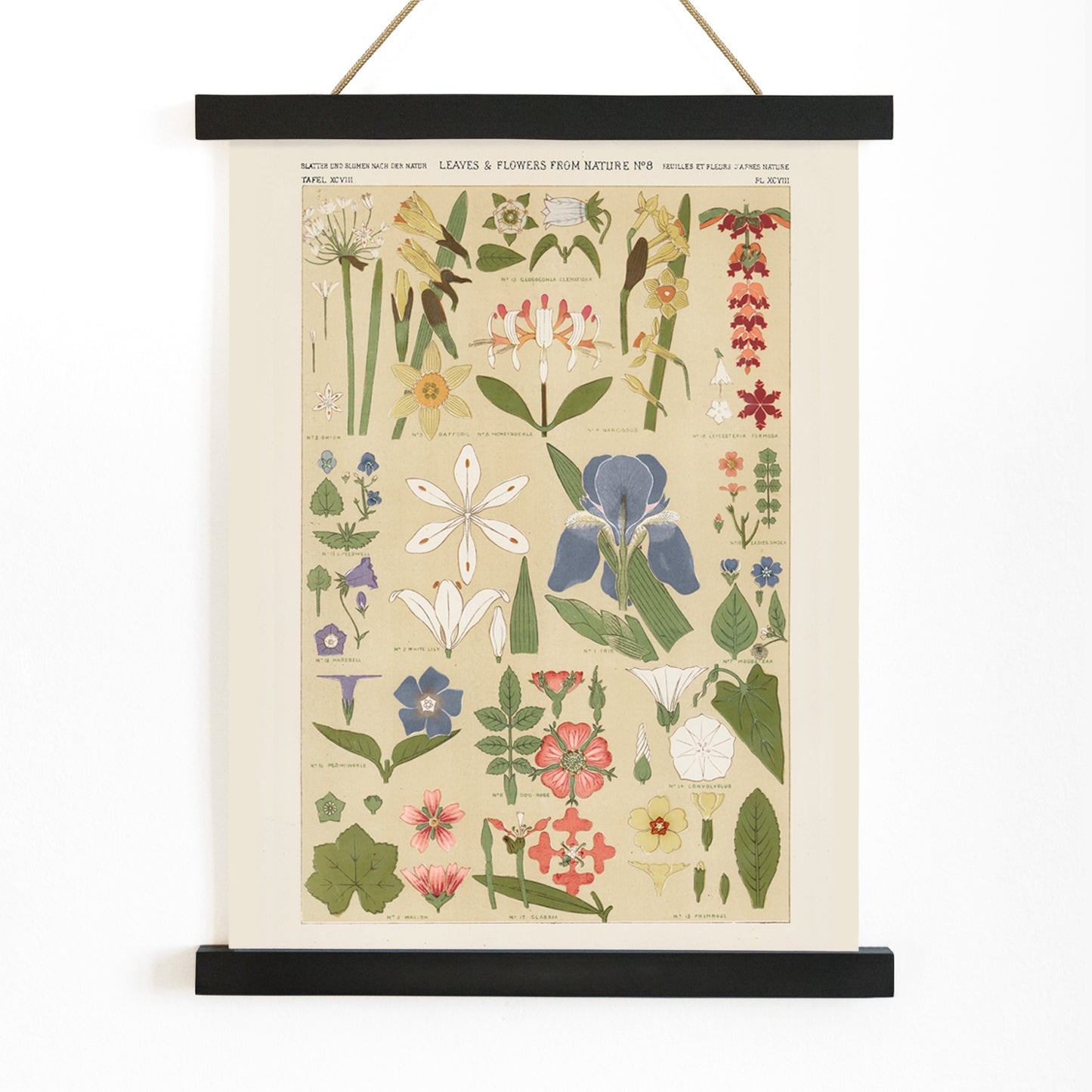
Leaves and Flowers was created as part of Jones's mission to educate and inspire through visual examples of stylized natural forms. In the context of nineteenth-century design reform, such plates were intended to guide the creation of tasteful, original decoration for interiors and manufactured goods. By abstracting botanical elements, Jones encouraged artists to move beyond literal imitation and embrace the underlying structures of nature.
Produced during a period of rapid industrialization and international exchange, this work reflects the Victorian ambition to harmonize beauty and utility. It stands as a testament to the era's fascination with both scientific observation and creative transformation of the natural world.
Style & Characteristics
The image features a symmetrical arrangement of stylized leaves and floral motifs, each outlined with clarity and filled with flat areas of color. The composition is orderly and architectural, with repeated forms creating a rhythmic visual flow. Jones employs a palette of soft greens and blues, contrasted with a warm beige background and highlighted by subtle red accents that enliven the design.
This decorative approach emphasizes pattern and surface rather than depth, typical of nineteenth-century ornamental art. The overall effect is refined and harmonious, making the print a versatile choice for those interested in botanical prints or seeking to incorporate historical pattern into their interiors.
In Interior Design
This botanical print brings a sense of structure and calm to a variety of spaces, from living rooms and studies to creative workspaces. Its balanced design and gentle color scheme pair well with natural materials like wood and linen, as well as with muted green or blue accents.
For a cohesive look, consider combining it with other works from green tone art or framing it in a simple profile from our frames collection. The print's ornamental elegance makes it suitable for both traditional and contemporary interiors.