


You may also like
-
Humain Brain Poster
Institute of Liepzig · 1869 · Detailed human brain scientific print with labeled anatomy on warm beige paper
Poster from €9 · Framed from €16
Regular price From €6,00Regular price -
Human Skeleton Poster
Institute of Liepzig · 1900 · Detailed human skeleton scientific print with crisp linework on warm beige paper
Poster from €9 · Framed from €16
Regular price From €6,00Regular price -
Human Blood System Poster
Institute of Liepzig · 1906 · Detailed anatomical poster mapping blood circulation with red and blue vessels on beige
Poster from €9 · Framed from €16
Regular price From €6,00Regular price -
Planiglobes of the Earth I Poster
Institute of Liepzig · 1860 · Detailed hemispheric world map vintage print with crisp graticules and antique typography
Poster from €9 · Framed from €16
Regular price From €6,00Regular price


-

"Very nice Posters. The quality is amazing and we received it very quickly !"
-

"A shop to visit absolutely. Huge selection of posters. We spent more than an hour there !"
-

"Perfect to find gift. Price are very good. An they can frame and pack it on site"


About the Artist
Institute of Leipzig refers to an academic institution rather than an individual artist, reflecting the early 20th-century tradition of producing authoritative teaching charts for scientific and medical education. In 1924, such plates were essential resources in classrooms, valued for their accuracy and clarity as much as their visual appeal.
This vintage anatomical print embodies the institutional rigor of educational wall charts, serving as a bridge between scientific knowledge and visual culture. It naturally complements other science wall art and appeals to collectors, students, and those with an appreciation for historical academic imagery.
The Artwork
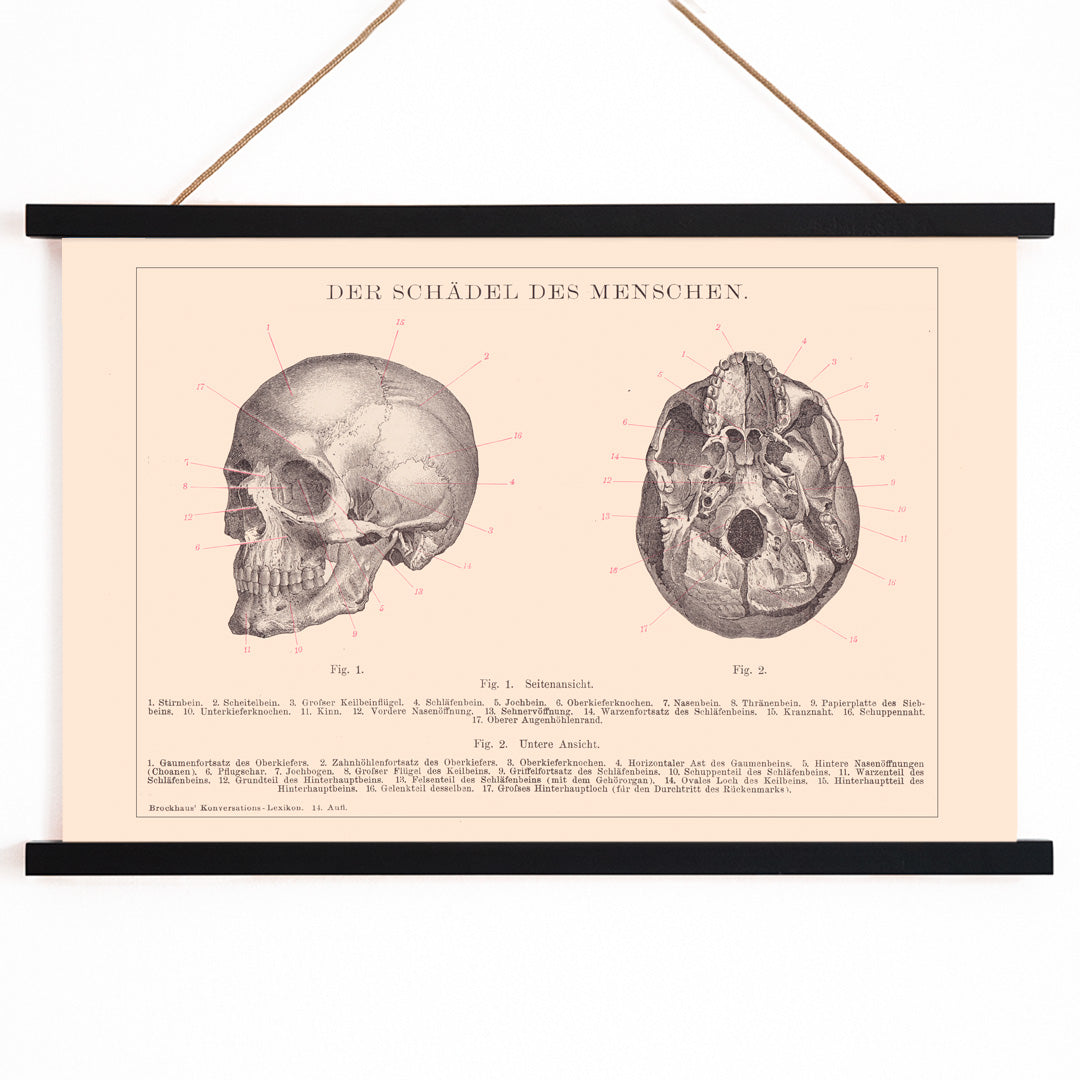
Created for anatomical instruction, this human skull chart was designed to facilitate learning in medicine, dentistry, and anthropology. Such diagrams provided a universal visual language for students and educators, making complex structures accessible and memorable during lectures and study sessions.
Produced in 1924, the print reflects a period when printed reference materials were indispensable in academic settings. Today, it continues to convey its original intent: encouraging close observation, comparison, and a respect for scientific inquiry as part of daily life.
Style & Characteristics
The composition features the human skull from multiple perspectives, including side profiles and a base view, arranged with the precision of a scientific reference plate. Delicate linework and subtle shading articulate the bone structure, while clear anatomical labels enhance its instructional value.
The restrained palette of beige background and grey rendering imparts a calm, archival quality to the image, making it ideal for interiors that favor scholarly or minimalist aesthetics. For those drawn to understated tones, explore more beige tone prints that harmonize with vintage scientific artwork.
In Interior Design
This print is particularly suited for home offices, studios, or reading nooks, where it introduces focus and a sense of intellectual curiosity. It also fits well in clinics or consultation spaces, adding historical depth without overwhelming the environment.
Pair it with warm whites, natural wood, and charcoal accents for a modern minimalist look, or set it against darker walls for a museum-inspired effect. Framing it with one of our frames elevates its presence as a refined art piece.